Choosing a dining room set isn’t just about finding something that fits in the corner. It’s the command center of your home, where assignments gets done, holidays get celebrated, and Tuesday night takeout turns into real conversation. Get it right, and you’ve got a piece of kitchen dining room furniture that’ll serve your household for decades. Get it wrong, and you’re stuck with wobbly chairs and a table that crowds the room. This guide walks through the practical decisions that separate a smart buy from a regrettable one, covering everything from clearance requirements to finish durability.
Table of Contents
ToggleKey Takeaways
- Measure your dining room and subtract 6 feet of total clearance (3 feet per side) before selecting a furniture dining room set to ensure chairs pull out comfortably and traffic flows smoothly.
- Solid hardwood dining room sets last generations and can be refinished if damaged, while veneer and laminate are budget-friendly but harder to repair once compromised.
- Choose your dining room set style based on your home’s architecture and lifestyle needs—traditional farmhouse suits open concepts, while modern and contemporary styles work best in neutral spaces with clean lines.
- Match seating capacity to real-world use rather than fantasy entertaining; an extendable table with a leaf accommodates guests without crowding the room on everyday occasions.
- Consider durability finishes like catalyzed lacquer or conversion varnish for wood surfaces, and prioritize scratch-resistant materials and wipeable upholstery if you have young children or pets.
- Budget ranges from $400–$800 for big-box sets to $2,500+ for custom builds; choose retailers based on timeline and viewing preferences, from budget chains to local makers offering personalized dimensions and quality.
What to Consider Before Buying a Dining Room Set
Before browsing catalogs or showrooms, measure the room and assess daily use. A dining set is an investment piece, most homeowners keep theirs for 10 to 15 years, so thinking through function upfront prevents buyer’s remorse.
Room dimensions matter more than table aesthetics. Measure the length and width of the dining area, then subtract 6 feet (3 feet per side) to determine maximum table dimensions. That 3-foot clearance allows chairs to pull out and people to walk behind seated diners without turning sideways. For rooms that double as walkways, bump clearance to 42 inches on the traffic side.
Seating capacity should match real-world use, not fantasy dinner parties. A family of four might want seating for six to accommodate guests, but an eight-seat table in a small room creates daily frustration. Standard chair width is 18 to 24 inches, with 24 to 30 inches of table length per person. If hosting large gatherings matters, consider an extendable table with a leaf rather than oversizing the everyday footprint.
Lifestyle factors include kids, pets, and how often the table sees action beyond meals. Homes with young children benefit from rounded corners and finishes that hide dings. If the table doubles as a home office or craft station, prioritize scratch-resistant surfaces like hardwood with a durable topcoat or laminate. Pet owners should skip delicate upholstery on chairs, wipeable vinyl or treated fabric holds up better against paws and accidents.
Budget varies wildly. Big-box retailers offer complete five-piece sets starting around $400 to $800, typically particleboard or veneer construction. Solid wood sets from mid-range furniture stores run $1,200 to $3,000. Custom or heirloom-quality pieces can exceed $5,000. Plan to spend proportionally: if you’re in a starter home, a budget set makes sense: if this is a forever house, investing in solid construction pays off.
Popular Dining Room Set Styles for 2026
Style trends shift, but the core categories remain consistent. Choosing a style that complements existing architecture and personal taste ensures the set won’t feel dated in five years.
Traditional and Farmhouse Dining Sets
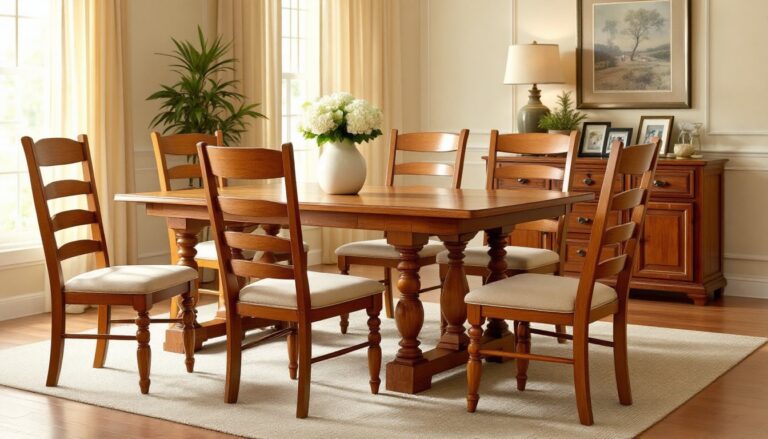
Traditional sets feature turned legs, ornate details, and rich wood tones, cherry, mahogany, or walnut. They pair well with formal dining rooms, wainscoting, and crown molding. Expect solid wood construction, dovetail joinery in drawers (if the set includes a buffet or hutch), and upholstered chairs with nailhead trim.
Farmhouse style took over in the 2010s and hasn’t let go. Defining features include trestle or pedestal bases, plank-style tops (often reclaimed or distressed wood), and mixed materials, wood tables paired with metal chairs or benches. The look reads casual and works in open-concept layouts. Farmhouse sets typically use oak, pine, or acacia, sometimes with a weathered or whitewashed finish. Be cautious with distressed finishes if you have small kids, those intentional dings can hide real damage, making it harder to assess wear over time.
Modern and Contemporary Options
Modern dining sets emphasize clean lines, minimal ornamentation, and mixed materials. Common pairings include glass or marble tops with metal bases, wood tables with geometric legs, or monochromatic lacquered finishes. Chairs often skip arms and heavy padding in favor of molded plastic, bentwood, or slim upholstery.
Contemporary sets blend modern elements with softer touches, think walnut tables with mid-century tapered legs or live-edge wood paired with Scandinavian-style chairs. These sets work well in homes with neutral palettes and open floor plans. Many contemporary designs featured on sites like Design Milk showcase mixed seating (four chairs plus a bench) for visual interest and flexibility.
Mid-century modern remains a strong subcategory. Look for tapered or splayed legs, warm wood tones (teak, walnut), and chairs with curved backs. Authenticity matters here, true mid-century pieces command high prices, but reproductions from retailers like Ashley Furniture deliver the aesthetic at accessible cost.
Choosing the Right Size and Shape for Your Space
Table shape affects both capacity and flow. Each shape has trade-offs in how it uses floor space and accommodates diners.
Rectangular tables are the workhorse option. They seat the most people, fit naturally against walls or in long rooms, and accept leaves for expansion. A standard 60-inch rectangular table seats six comfortably: 72 inches handles eight. For narrow rooms (10 feet wide or less), keep table width to 36 to 42 inches to preserve clearance.
Round tables maximize conversation and work well in square rooms. A 48-inch round seats four: 60 inches fits six. The lack of corners improves traffic flow in tight spaces, but round tables don’t expand easily, adding a leaf often creates an awkward oval. They’re ideal for breakfast nooks or smaller formal dining areas.
Square tables suit square rooms and small households. A 36-inch square seats four snugly: anything larger feels oversized unless the room is proportionally large. Square tables create intimacy but lack flexibility for extra guests.
Oval and racetrack tables split the difference between rectangular and round. They offer the seating capacity of a rectangle with the softer edges of a round. An oval table in a narrow room can improve flow compared to a sharp-cornered rectangle.
Before finalizing size, mock up the footprint with painter’s tape on the floor. Add chair positions (pulled out 24 inches from the table edge) to visualize actual clearance. This step catches sizing mistakes that measurements alone miss. For detailed guidance on proper clearances and proportions, furniture measurements standards that prevent common layout errors.
Materials and Durability: What Lasts Longest
Material choice determines how the set holds up under daily use and how much maintenance it requires. Not all wood is created equal, and finishes matter as much as the substrate.
Solid hardwood (oak, maple, cherry, walnut) is the gold standard for longevity. Properly maintained hardwood tables last generations. Oak is durable and affordable: walnut offers rich color but costs more. Hardwoods dent and scratch, but they can be sanded and refinished, a major advantage over veneer or laminate. Expect solid wood sets to start around $1,500 for mid-grade construction.
Veneer over engineered wood uses a thin layer of real wood glued to plywood or MDF. It looks like solid wood and costs less, but damage to the veneer (deep scratches, chips, water infiltration) can’t be easily repaired. Quality varies, furniture-grade plywood core is sturdy: particleboard core is not. Check edge banding (the strip covering the core at table edges). If it’s peeling in the showroom, it’ll fail at home.
Metal bases (steel, iron, aluminum) pair with wood, glass, or stone tops. Powder-coated steel resists rust and holds up well indoors. Wrought iron adds weight and stability but requires touch-up if the finish chips. Metal works well in industrial or modern styles and simplifies cleaning, no wood grain to trap crumbs.
Glass tops are easy to clean and visually light, ideal for small spaces. Tempered glass is mandatory for safety, it shatters into small chunks rather than sharp shards. Glass shows fingerprints, water spots, and scratches from placemats or serving dishes. Pair glass with a sturdy base: a wobbly frame plus a rigid top is a recipe for stress fractures.
Laminate and composite materials mimic wood or stone at low cost. High-pressure laminate (HPL) resists scratches and heat better than paper-backed laminate. It’s practical for high-traffic households but won’t age gracefully or gain patina. If budget is tight, laminate beats a flimsy solid wood set.
Finish quality protects the material. Catalyzed lacquer or conversion varnish offers the best durability for wood, resisting water, alcohol, and heat better than traditional lacquer or oil finishes. Test by pressing a thumbnail into an inconspicuous spot, it shouldn’t dent easily. Avoid wax finishes in homes with kids: they require frequent reapplication and stain easily.
Where to Buy Quality Dining Room Sets on Any Budget
Sourcing strategies depend on budget, timeline, and willingness to assemble or transport pieces yourself.
Big-box retailers (IKEA, Target, Wayfair, Amazon) offer budget-friendly sets with fast delivery. Prices range from $300 to $1,200. Assembly is typically required, expect 1 to 3 hours with basic tools (Allen wrenches, screwdrivers). Quality is hit-or-miss: read reviews carefully and filter for mentions of stability and finish durability. Return policies matter here, damaged or wobbly pieces need hassle-free returns.
Mid-range furniture chains like Nebraska Furniture Mart and Rooms To Go stock a wide selection with in-person viewing. Prices run $800 to $3,000 for full sets. Many offer white-glove delivery (delivery crew brings it in, assembles, and removes packaging). Floor models sometimes go on clearance at steep discounts, inspect for damage, but minor dings can be touch-up opportunities.
Local furniture makers and custom shops build to spec. Expect $2,500 and up, with lead times of 6 to 16 weeks. Custom work allows control over dimensions, wood species, and finish. It’s worth the investment if room dimensions are unusual or you want heirloom quality. Ask for references and inspect previous work, joinery and finish quality should be flawless.
Secondhand and vintage sources (estate sales, Craigslist, Facebook Marketplace, consignment shops) can yield solid wood sets at fraction of new cost. Older furniture often has better construction than modern budget pieces, dovetail joints, solid wood throughout, repairable finishes. Budget time for pickup, cleaning, and possibly refinishing. Avoid sets with active pest damage (small holes, sawdust trails) or structural wobbles that can’t be fixed by tightening hardware.
Online-only brands (Article, Burrow, Interior Define) focus on modern styles and direct-to-consumer pricing. Sets range from $1,000 to $2,500. Shipping is often free, but returns can be complicated for large items. Reviews on Homedit and similar platforms help gauge quality since you can’t see pieces in person. Many brands offer fabric or finish samples by mail, order them before committing.
Outlet stores and clearance centers sell floor models, discontinued lines, and overstock. Prices are negotiable, and discounts can hit 40 to 60% off retail. Inspect thoroughly, floor models endure showroom abuse. Bring a level to check for wobbly legs and examine joints for looseness. Outlets typically sell as-is with limited or no returns.
For guidance on evaluating quality and styles across price points, the curated recommendations at Elle Decor’s dining table guide offer a useful benchmark when comparing options.